

Over 1000 STEM faculty at the University of California (UC) have signed an open letter exposing the profusion of UC undergrads unprepared for basic instruction in calculus, criticizing the waste of talent it entails, and calling on the Board of Regents to reinstate standardized testing in STEM admissions. Their courageous step will doubtless be criticized as racist, as the underprepared applicants are disproportionately Hispanic and Black. In reality it augurs a return to the non-racial assessment of STEM merit, where UC was once the world’s exemplar. UC Berkeley awarded Black professors tenure in STEM more than a decade before any other leading university. One of them, David Blackwell, is acclaimed to this day for his seminal contributions to information theory and statistics.
As noted in a previous essay, UC efforts to boost Hispanic and Black shares led it to ban the use of ACT/SAT scores, despite a UC study confirming their high predictive power for future academic success and lack of prejudice. Despite the UC Faculty voting 51-0 to retain standardized testing, UC’s governing Board of Regents decided 23-0 against.Admissions not only became more school-specific (the top 9% at each school are effectively guaranteed admission, despite vast differences in school quality) but also favored the easiest-grading schools.
UC STEM faculty carefully documented “a widening divergence in mathematical preparation levels”. Consider UC San Diego, where nearly 90% of entering first-year students need to take math for their majors. In both fall 2020 and fall 2025, about 55% of those placed in second-year calculus or higher (Table 1), which suggests competence at the high end remained broadly the same. Over the same period, competence at the low end plunged. The share of math placements to middle school review (more precisely, pre-precalculus) rose from less than 1% in fall 2020 to 13% in fall 2025.
The low-end students were overwhelmingly the achievers of high grades at schools with low standards, which in California is highly correlated with “mostly Hispanic and Black”. Advocates defend their admission to UC (as opposed to California State Universities or Community Colleges, which are better geared to serving slower learners or late starters at lower costs with less pressure) on the grounds that low standards reflect institutional racism. They hope to raise the vistas of low-end enrollees, darken the complexions of STEM grads, and promote interracial respect.
Yet the evidence tells against this. Of students who started at USCD 2017-2023 in lowest-level math, hardly any entered an Engineering major, and 30% received a D, F, or Withdrew (DFW) in the calculus course required for Psychology BS or most Biology majors. This could not help but heighten the observed correlations between math achievement and race, exactly opposite to what was hoped.
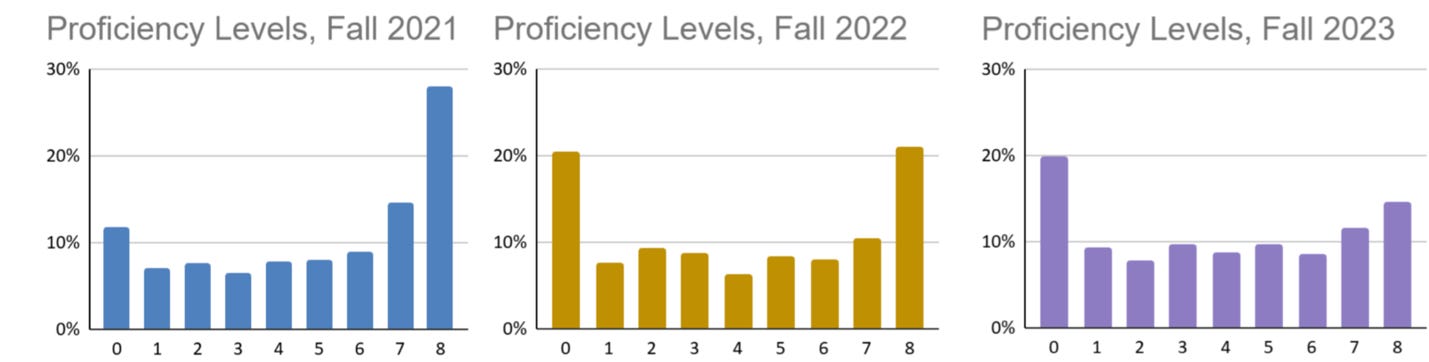
Similar divergence was documented at UC Berkeley in preparation for Calculus 1:
With overall precalculus proficiency at most 50%, the share of strongly prepared students is shrinking while the share of students with severe preparation deficits is growing and now accounts for roughly one-third of the 2023 cohort. The resulting U-shaped bimodal distribution has polarized the classroom into groups that are hard to teach at the same time. Crucially, the most underprepared students are 10 times more likely to fail than their prepared peers, and even the merely underprepared students are now 5 times more likely to fail.
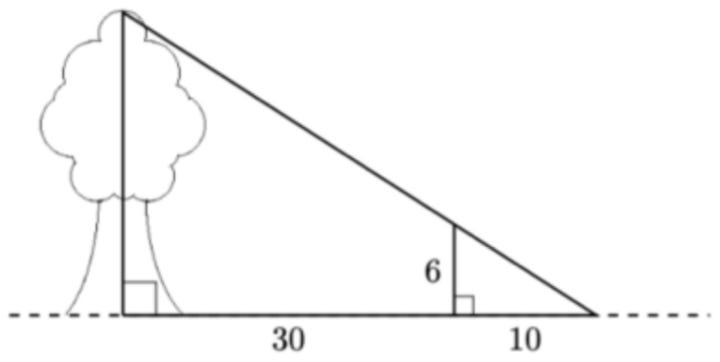
Less than half of tested Calculus 1 students at Berkeley could identify the set {x^2>4}. Less than half could identify the height of this tree:
As the open letter aptly notes,
Basic mathematical fluency is analogous to literacy; without it, success in university-level STEM becomes structurally unattainable for students.… Furthermore, the widening spread between underprepared and well-prepared students creates polarized courses, weakening the foundation available to many students and making it harder to teach at the level required for advanced STEM work. UC is increasingly unable to provide its students with the education needed to become leaders in California’s scientific, technological, and economic future. We are already seeing the warning signs: longer pathways through prerequisite material, reduced readiness for advanced coursework, and growing pressure to dilute quantitative rigor.
Read the rest of the open letter for its specific recommendations, including resumption of standardized testing. Note too what the letter doesn’t mention: Diversity, Equity or Inclusion. I find that admirable in several ways:
It is measured. The signatories vouch for what they are experts on, without weighing in where they are not.
It is bold. They pay no ritual fealty to the DEI mantras that have dominated university parlance for over a decade.
It raises the bar. They demand a refocus on excellence that transcends bean counts for race, ethnicity, or gender.
Since no good deed goes unpunished, I expect signatories to be vilified as racist. How dare they aim to be colorblind! How dare they defend white supremacy through promotion of… Asians and Jews! Are they not dog-whistling for a return to Jim Crow?
No, they are not. On the contrary, they are seeking to reclaim one of UC STEM’s finest traditions. In the 1950s, UC Berkeley granted tenure to two Black professors in STEM. While this had been wrongly delayed due to skin color, it came more than a decade before any other leading university granted tenure to Blacks in STEM, and without the slightest doubt that tenure was deserved. One of the two, David Blackwell, was highly honored both in his lifetime and after for his pioneering contributions to information theory. In 2024, Nvidia’s Blackwell GPU architecture was named in his honor.
I first heard of Blackwell’s theorems when studying for my economics PhD at Berkeley. No one mentioned that Blackwell was Black; I learned that by chance only two decades later when my son dated his granddaughter. To me that speaks well of both Berkeley’s and Blackwell’s priorities. Discovery matters more than the face of its vessels. But I emphasize his face now as an antidote to Bayesian bias. Promoting underprepared Hispanics and Blacks to STEM classes they can’t handle encourages more racial stereotyping. Berkeley’s promotion of Blackwell refuted it.
I applaud the UC STEM faculty signatories for their courage. Hopefully they can restore UC’s quest for colorblind excellence and encourage others to follow suit.
Cudos to the UC STEM faculty for speaking out! We must save STEM higher education, and the first step towards it is to fix the admissions. Admissions should based on merit, that is, academic preparedness of students to take university-level courses. And standardtized tests provide crucial information about students' preparation.
Long before gay rights became a major social movement, I knew a highly accomplished scientist who was openly gay. When the push came to mix scientists' identities into public information, I asked him if identifying him as gay to others when talking about his accomplishments would matter to him. He looked at me like I'd grown horns. He put it succinctly, that his being gay had absolutely nothing to do with his science. As a woman in a male-dominated field who kept being held up (against my wishes) as some kind of exemplar for women in STEM, I could not have agreed more. I am SO glad I came up in an era when merit mattered. I've really resented the few times people have tried to insinuate that I got where I did because the path was smoothed for me for my sex. No, it wasn't. In any case, as the failure rates at the university show, having the path smoothed only gets you so far if you are not up to the task. By the time I was halfway through my career, I stopped hearing those insinuations.