


This oped was first published in the Chronicle of Higher Education on July 31, 2026.
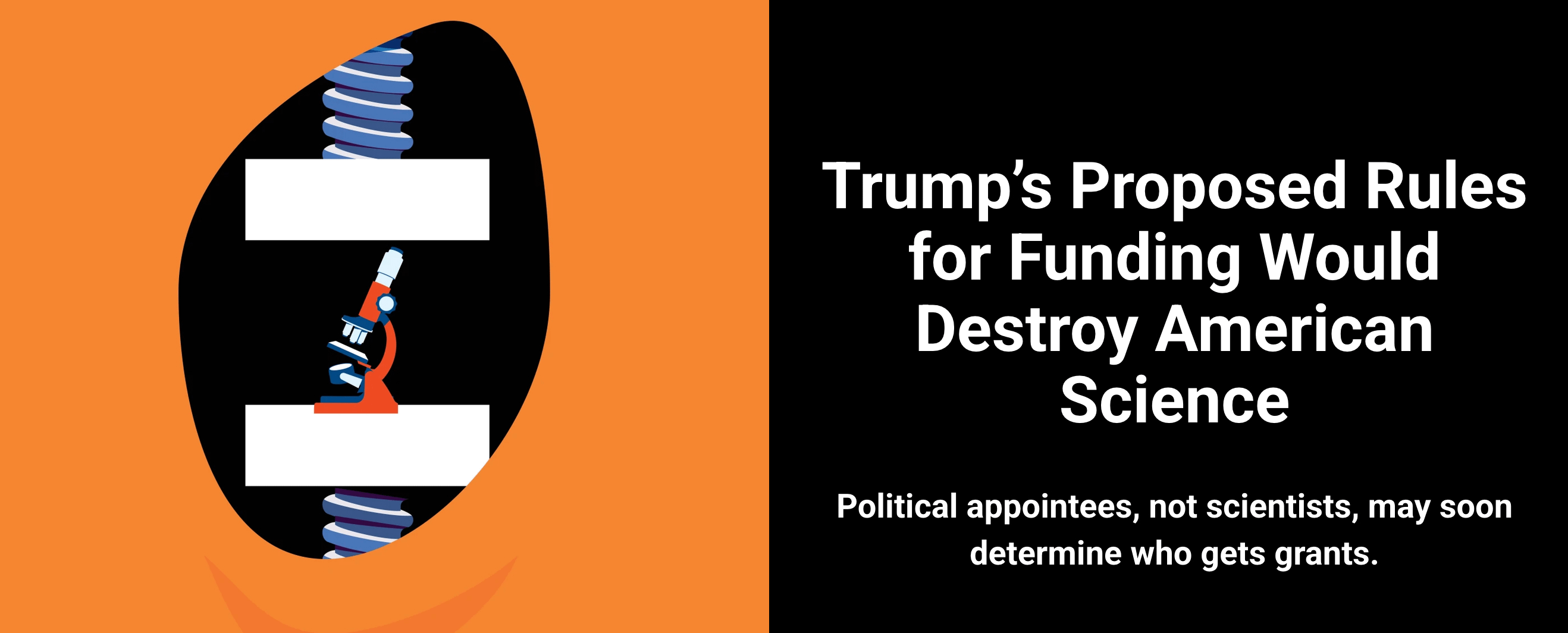
Many scientists were among the 500,000 people who submitted comments to the Office of Management and Budget during the six-week public-comment period following the posting of newly proposed rules on federal science funding that would drastically alter how grants are reviewed, awarded, and administered. In the future, this may be the touchstone event we recall and say, “Scientists finally arose from their civic slumber.”
One of us specializes in the math that describes molecules traveling through the human body. The other specializes in the math of what makes molecules tick. Like most scientists, we have spent our lives achieving an extraordinary level of expertise on a technical matter — sometimes by ignoring the world around us. Neither of us was trained in science administration or national science policy. And yet, our professional careers are heavily influenced by both. While we have many colleagues who see themselves as above politics and abjure all political affiliations, we have come to believe that when scientists remain outside the arena that sets policy — i.e., the democratic process — they do so at their peril.
Over the past few years, some of us have become increasingly alarmed by the politicization of science administration and science policy. Politicization has come from both the left and the right. In 2024, one of us wrote about the perversion of science funding by the Biden administration, ostensibly to achieve its social-justice goals. Now, we have written a follow-up paper that calls out the dangers of the politicization of science funding that’s being embraced by the Trump administration, this time in the name of improving efficiency and reversing ideological distortions by the previous administration. Whether political control comes from the left or the right, the result will be the loss of our technological supremacy, with devastating consequences for industry and society at large. Moreover, the volatility in how science is prioritized and funded is itself damaging to the scientific enterprise.
The politicization of science need not reach the extremes of Lysenkoism in the Soviet Union — in which bogus, state-mandated agricultural science led to death and destruction — to do serious damage to science and public trust. Although less cataclysmic, U.S. history also offers examples of political influence distorting the scientific process. The case of stem-cell research illustrates how politicization can pit one political side against another to skew government policy and reward complicity within the scientific community. In the early 2000s, federal regulators imposed restrictions on embryonic stem-cell research. In subsequent years, unconditioned support for stem-cell therapies — often ahead of conclusive evidence — became a political litmus test on the left. With scientific scrutiny suppressed in the name of political alliances, wildly optimistic claims about imminent breakthroughs, such as treatments for heart failure, outpaced available data. Substantial public funding was directed to these efforts at the expense of alternative approaches to cardiovascular disease. Subsequent investigations led to the retraction of several highly cited studies, making it clear that scientific rigor and oversight had been compromised.
Today, according to some surveys, only 28 percent of Americans have a great deal of confidence in scientists to act in the public’s best interests, down from 39 percent in 2020. Trust in higher education is even lower — more than two-thirds of Americans say colleges are “headed in the wrong direction.” Much of the public has come to see science as just another cynical political grab for power and money. Politicization is partly to blame.
Politicization is distinct from politics and the political process, which are both part and parcel of a functioning democracy. The public elect representatives who, in turn, set the priorities for the allocation of public monies. That’s as it should be. Politicization, by contrast, is something both more subtle and more sinister. What made Lysenkoism so devastating in the Soviet Union was not just that the Communist Party set unrealistic agricultural goals or imposed disastrous policies such as collectivization. Rather, it was that the Communist Party claimed the authority to adjudicate scientific truth.
How can anyone — politics-phobic scientists hoping to remain above the fray — tell the difference between legitimate involvement in science policy and political interference in it?
We start by asking some basic questions: 1. Do political considerations drive and determine the outcomes of the research? 2. Are the funds allocated for only a certain group or class of investigators, but not available to others of comparable or superior qualifications? 3. Are investigators prohibited from employing the best scientific or technological tools or theories? 4. Is the language that can be used to describe the proposed research limited or monitored? 5. Is the process of identifying the best proposals for funding controlled by political appointees rather than scientists? 6. Is the process of awarding funds opaque?
Analyzing recent actions by the Trump administration through this lens reveals troubling instances of politicization of science funding. Most alarming, the Office of Management and Budget’s proposed rule would require all scientific awards and funding decisions to be reviewed and approved by senior political officials. This would be an unprecedented step, upending a framework of scientific funding in which political leadership sets broad priorities, but the implementation of those priorities — that is, determining what specific scientific proposals would best fulfill them — is left to review committees composed of scientists.
Political officials lack the expertise to evaluate the merits of technical proposals. At best, they could do little more than rubber-stamp the decisions of scientific panels and program officers. At worst, they could make deleterious, politically motivated decisions. Empowering politicians to adjudicate which scientific ideas to advance and which to nix evokes chilling parallels with Lysenkoism. Inserting political appointees into the funding process will institutionalize the politicization of science and transform scientific funding into a political football to be kicked in whichever direction the party in power happens to favor.
It cannot be overstated how radical a proposal this is: It would overturn a model of science funding that America has followed — with overwhelming success — since the end of World War II. Elected officials establishing budgets and broad priorities, and then getting out of the way to allow scientific experts to determine which specific proposals have the greatest scientific merit, are what have enabled the United States to become the uncontested world leader in scientific research.
But it is important to acknowledge that we scientists bear some responsibility for the political whiplash in science funding. We remained mostly quiet as ideological distortions of science picked up speed, undermining the principles of meritocracy and open inquiry, and subverting our key knowledge-producing institutions. We were too apathetic — or too enmeshed in our own work — to participate in policy discussions.
We urge our colleagues to come down from their ivory towers and engage. Instead of complaining about the system, we must educate ourselves about science policy and the workings of the federal government. There are certainly differing worthy opinions about the prudence of using federal coffers — and how much of them — to pay for basic science research. But there are reasons why American science has been the envy of the world for the last 80 years and more. It is time for all scientists to engage.

"But it is important to acknowledge that we scientists bear some responsibility for the political whiplash in science funding. We remained mostly quiet as ideological distortions of science picked up speed, undermining the principles of meritocracy and open inquiry, and subverting our key knowledge-producing institutions. We were too apathetic — or too enmeshed in our own work — to participate in policy discussions."
To be honest, this is the part that scares me the most. A lot of academics, even some scientists, didn't see the ideological distortions under the Biden administration as a problem and continue to defend them even as the current administration tried to reverse those distortions and insert their own.
The authors ask some very relevant questions that must be answered to decide if science is being politicized. I restate their questions and the state of academic science PRIOR to the Trump administration's recent efforts in paranthesis below each.
1. Do political considerations drive and determine the outcomes of the research?
(Yes...political considerations in the partisan scientific community dictated what research is conducted.)
2. Are the funds allocated for only a certain group or class of investigators, but not available to others of comparable or superior qualifications?
(Yes...only tenure track/tenured faculty are given access to research funding which means the extremely partisan faculty staffing universities deny 75% of PhD's the ability to even participate in the research process.)
3. Are investigators prohibited from employing the best scientific or technological tools or theories?
(Yes....see #2 and the consequences to any scientist who dares to question the canon of left wing ideology in science.)
4. Is the language that can be used to describe the proposed research limited or monitored?
(Yes...see #2 and #3)
5. Is the process of identifying the best proposals for funding controlled by political appointees rather than scientists?
(Yes...federal agency program managers who are predominantly on the political left control funding decisions.)
6. Is the process of awarding funds opaque?
(Yes...while scientific panels score proposals, the actual funding decisions remain opaque.)
Given the state of science as created by the academic community prior to President Trump's taking office, it is far too late to complain about the politicization of science. The Trump administration's efforts to DEPOLITICIZE science may not all be fully thought through and some may have unexpected consequences, but the scientific community simply has no credibility in arguing that the government does NOT have the right or need to intervene to de-politicize science. If you doubt this...let us not forget that massive numbers of scientists began protesting the first Trump administration before it had taken ANY actions in 2017 with the "Marches for Science". The scientific community politicized science long before the Trump administration took any action. Time to stop projecting and accept the consequences of those poor decisions.
Do I trust political appointees to make high level policy decisions on the funding of science? Not particularly...but at least they are accountable to the public via election of those who appoint them. The scientific community, as we have seen with Anthony Fauci, Ecohealth Allianc etc. is even LESS trustworthy than political appointees in this regard...and they are not subject to recall or replacement in regular elections.
Sorry...but the scientific community is on the wrong side of history on this one.