

I find myself despondent about the direction of my country and increasingly of our entire civilization. Across the Western world, millions of people express frustration with rising costs, declining social trust, and institutional dysfunction. Many sense that something fundamental is unravelling. Yet election after election, many of those same societies continue to embrace the ideas, policies, and leaders that helped produce those outcomes.
As a Canadian, I recently watched this process unfold. After years of public frustration with Justin Trudeau’s government, many voters appeared eager to believe that Trudeau himself—not the ideology, policies, or political party, but Trudeau personally—was the source of the country’s problems. He became the scapegoat, and his party simply replaced him with Mark Carney. Many voters treated the change as a fundamental course correction, yet the broader ideological direction remained.
The scapegoating impulse is one of the oldest human tendencies. We possess a remarkable capacity to reduce complex social problems to a single villain. The impulse is emotionally satisfying because it simplifies reality and grants moral certainty. Once the scapegoat has been identified, the devil and halo effects begin to operate together. The villain can do no right, while others get a free pass.
I wish I could say this is a uniquely Canadian problem, but variations of the same phenomenon are unfolding throughout the Western world. The manifestations differ, yet the underlying pattern remains remarkably similar. I find myself asking a more fundamental question:
Why do free societies seem increasingly unable to recognize, preserve, and defend the very foundations that made them free in the first place?
The deeper problem lies beneath politics. Western civilization resembles a giant Jenga tower. Each block represents a principle that took centuries to build: free speech, equal justice before the law, limited government, merit, equal opportunity, free markets, personal responsibility, freedom of conscience, and perhaps most importantly, the notion that every individual possesses inherent dignity.
One by one, these blocks are being removed. Some are attacked directly. Others are quietly neglected. Still others are redefined beyond recognition. Each removal may seem manageable in isolation. Yet every Jenga player knows the outcome when enough foundational pieces are removed. The tower falls.
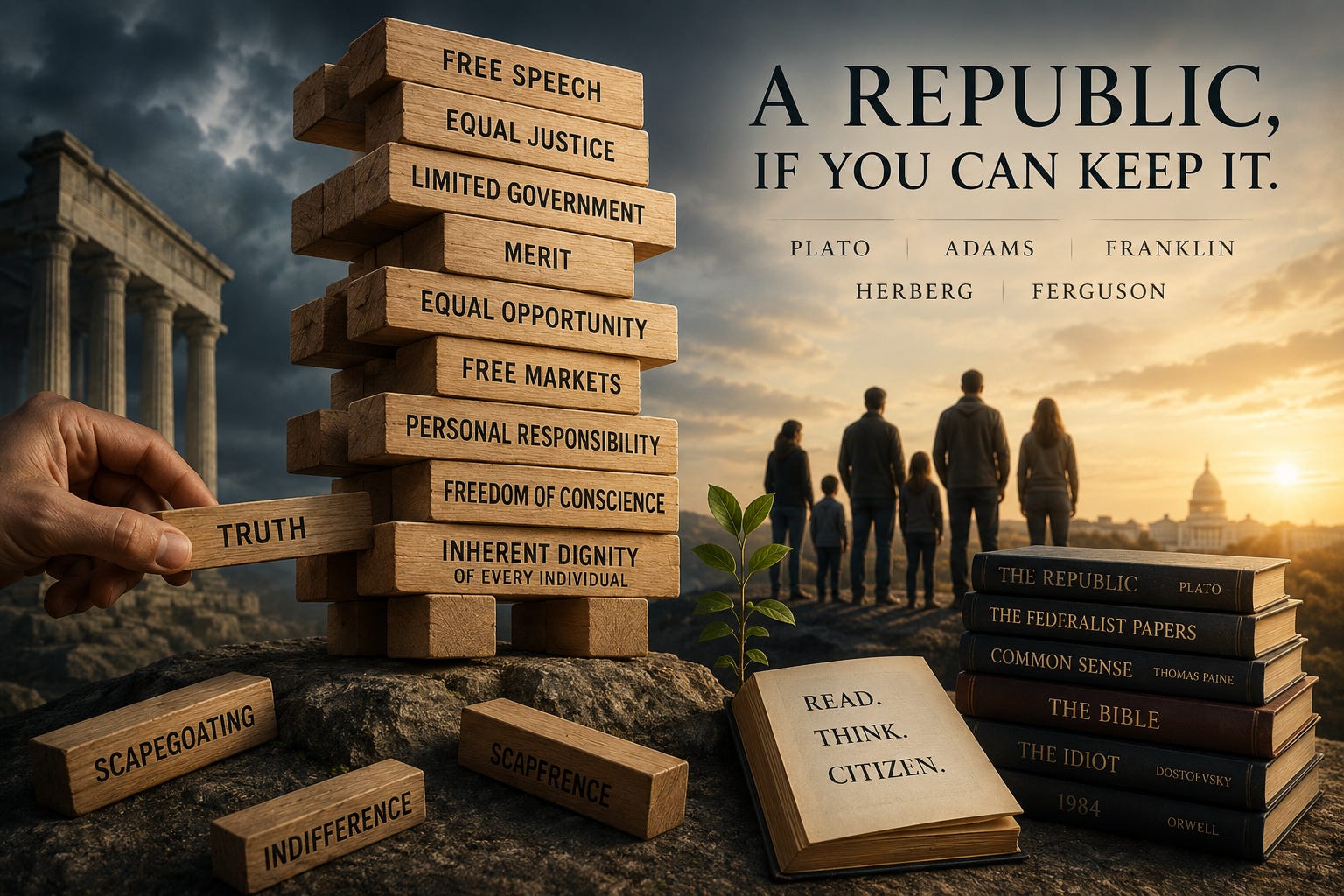
Sociologist Will Herberg coined the term “cut flower culture” to describe this phenomenon. The bedrock of the West grew from particular religious and philosophical roots. Cut flowers remain beautiful for a time after being severed from their roots, but eventually wither and die. Likewise, we increasingly dismiss the largely Judeo-Christian and Greco-Roman origins of our civilization while pretending we can perpetually enjoy its fruits.
As John Adams, the second American president, warned, “Our Constitution was made only for a moral and religious people. It is wholly inadequate to the government of any other.” Two millennia earlier, Plato observed that the price good men pay for indifference to public affairs is to be ruled by evil men. Such concerns are hardly new. As the problem is cultural, so must the solution be a grassroots renewal.
We need young people reading again. Read Shakespeare, Dostoevsky, Homer, and Orwell. Read the Bible. Read the books that formed our civilization, especially the ones modern educational institutions have decided are no longer essential. Classical education cultivates something that social media cannot: wisdom, perspective, and moral imagination.
Historian Niall Ferguson, a self-described “lapsed atheist,” argues that free societies depend upon cultural and religious foundations that secularism alone struggles to provide. He has likewise remarked that if he could give young people one piece of advice, it would be simple: read more and spend less time staring at screens. Indeed, I suspect a broader religious revival may already be underway, as many people come to realize that a life devoted to comfort, consumption, and endless distraction is ultimately incapable of satisfying the deeper longings of the human soul. Perhaps Nietzsche’s declaration of the death of God was not the final chapter after all.
Democracy is more fragile than we often imagine. We frequently assume that larger majorities produce greater wisdom. The Bible, by contrast, repeatedly suggests that crowds are highly susceptible to delusion, conformity, and moral panic.
If we wish to preserve our civilization, we must first understand that it is not self-sustaining. Free societies do not survive because of constitutions, courts, or politicians alone. They survive because enough citizens possess the character necessary to sustain them. Democracy is not ultimately protected by institutions, but by the people who inhabit them. We need citizens who are informed enough to recognize propaganda, principled enough to resist scapegoating, and courageous enough to defend truth even when it is unpopular.
The solution will not come from Ottawa, Washington, London, or Brussels. It begins much closer to home. Read the classics. Learn your history. Participate in public life. Recover the habits of citizenship. And rediscover the moral and spiritual foundations from which our civilization first drew its strength.
A free society can only be saved by citizens willing to become the kind of people capable of sustaining one.
Benjamin Franklin was reportedly asked what form of government the American founders had created. His famous reply was simple: “A republic, if you can keep it.”
Can we keep it?
The future of free societies depends upon the answer.
Mark D’Souza is a Toronto-based physician and author of Lost and Found: How Meaningless Living is Destroying Us and Three Keys to Fix it.
 | A guest post by
|
Academia needs harsh reform. Much of the rot starts there.
A retired Canadian professor of friend of mine who grew up in Ottawa, child of diplomat from the Canadian foreign service, commented that Trudeau's buffoonish nature placed some limits on his ability to cause trouble. Carney is much more dangerous because he comes across as a serious leader who sadly is likely to be more effective in imposing the dangerous policies of the Liberal Party.