
When a Demon Takes the Wheel
A Psychological Meditation on Possession, Agency, and Naming the Thing That Ruins Lives

There are moments in life when someone you know seems to disappear.
The body is there. The voice is familiar. But the person you trusted—the one who reasoned, loved, and chose freely—feels intermittently absent, slipping behind a rigid set of talking points or defensive reactions.
“It’s like they’re not themselves, or something has taken over… it’s like they’re possessed!”
Modern people often dismiss such language as primitive or superstitious. Yet metaphors endure because they frequently capture realities before we have precise terms for them.
What follows is not a claim about literal demons, but a phenomenological and moral description of what happens when something malignant takes hold of a person’s agency—reorganizing their values and acting through them rather than for them.
“Demonic possession,” in this sense, is not a metaphysical diagnosis, but a way of naming what it looks like when a person is no longer fully sovereign.
Replacement Religion and the Mechanism Beneath It
In Lost and Found, I used the term “replacement religion” to describe an incomplete belief system or value elevated to the highest rung of one’s hierarchy of meaning. These substitutes promise purpose, certainty, or moral clarity in the absence of a deeper, more coherent framework—but they rarely deliver. Instead, they demand increasing sacrifice while offering diminishing returns in fulfillment.
Sometimes the replacement god is ideological: communism, fascism, radical identity politics, or climate alarmism. Sometimes it is personal: pride, status, or money. Sometimes it is chemical, as in substance abuse. Other times it is relational, as in toxic or codependent forms of love. Increasingly, it can even be socio-cultural: celebrity worship or online identities that begin to organize a person’s sense of self. The specific object varies, but in every case one value rises to supremacy and crowds out all others.
Replacement religions describe what is worshipped, but they don’t explain what happens next. What I refine here is the underlying mechanism: demonic possession as the operating system that takes over once such a belief, desire, or ideology becomes dominant.
Life-Like Systems of Ideas
Certain systems of ideas behave less like opinions and more like organisms. Jordan Peterson once described such systems to me not as metaphors, but as something closer to living spirits. I’ve since come to see these as parasitic or predatory rather than neutral, organized around persistence rather than truth.
Strip away the Hollywood imagery and what remains is a clear phenomenological pattern: the person is no longer fully autonomous. Another organizing principle speaks through them, reshaping priorities, loyalties, and moral judgment while actively resisting exposure. When the host is questioned or the pattern is named—typically by an outside observer—the system erupts in dysregulated rage.
The key shift is that we are no longer dealing with a fully sovereign agent. Reason remains intact everywhere except where the possession operates—and the host remains largely unaware.
This same dynamic can scale beyond individuals to entire societies. History offers stark examples: the Soviet Union, Nazi Germany, and other totalizing movements were not merely collections of bad ideas, but cases of collective possession, where ideology colonized institutions, language, and moral perception. Ordinary people continued to work, love, and raise families until forbidden questions were asked—at which point hysteria, denunciation, or violence erupted.
Any system that demands total allegiance, suppresses dissent, and treats exposure as an existential threat risks becoming demonic at scale.
Where do you see this pattern operating today—and how confident are you that you are not inside one of them?
The 8 Signs of Recognizing Possession
1. Personality Fragmentation
The person you knew is sporadically present, but no longer in control. You catch fleeting glimpses of the old self before the reversion.
2. Resistance to Exposure
A defining feature of possession is that the demon does not want to be named. Exposure does not simply provoke disagreement; it triggers an eruption—often volcanic—marked by loss of composure and emotional control.
Addicts hide. Cults isolate. Ideological systems render certain questions radioactive. Across domains, scrutiny is treated as threat rather than inquiry. The moment the pattern is identified, the response escalates. World War II bombers knew they were over the target when the flak intensified. And there is a reason vampires live in darkness and burn in sunlight.
3. Difficulty of Escape
The stronger the demon, the tighter the grip. Attempts to disengage provoke withdrawal, panic, or identity collapse, and over time the cost of exit grows so high that remaining possessed begins to feel safer than leaving.
This is why gambling addicts often keep playing long after the losses are catastrophic. The same twisted logic appears in its most extreme form in cults. In Jonestown, the city of Jim Jones’ cult, armed enforcers guarded the perimeter, passports were seized, and defectors were murdered—because the system’s survival depended on preventing exit. In both cases, the cost of stopping grows larger than the cost of continuing.
4. Compulsive Lying
Truth becomes instrumental rather than binding. Reality is bent to serve the entity’s survival.
This is not occasional dishonesty—it’s structural. Lies are required, underpinned by a post-modern Pontius Pilate “What is truth?” stance.
5. Hierarchy Distortion
A single value rises to the top, crowding out all others. Short-term gain overrides long-term goods. Family, future, and conscience become negotiable.
Neuroimaging studies even show diminished activity in regions associated with cost–benefit calculation when people are willing to fight or die for a cause. Reason is quite literally sidelined.
In this state, morality is rewritten to serve the moment, producing a crude Nietzschean superman1: answering to no authority beyond the will now speaking through them, accountable to nothing external.
6. Relational Destruction
Primary bonds are sacrificed with little proportional remorse. Relationships with spouses, parents, siblings, and children become collateral damage.
7. Initial Allure
Demons are beautiful at the door and hideous when named.
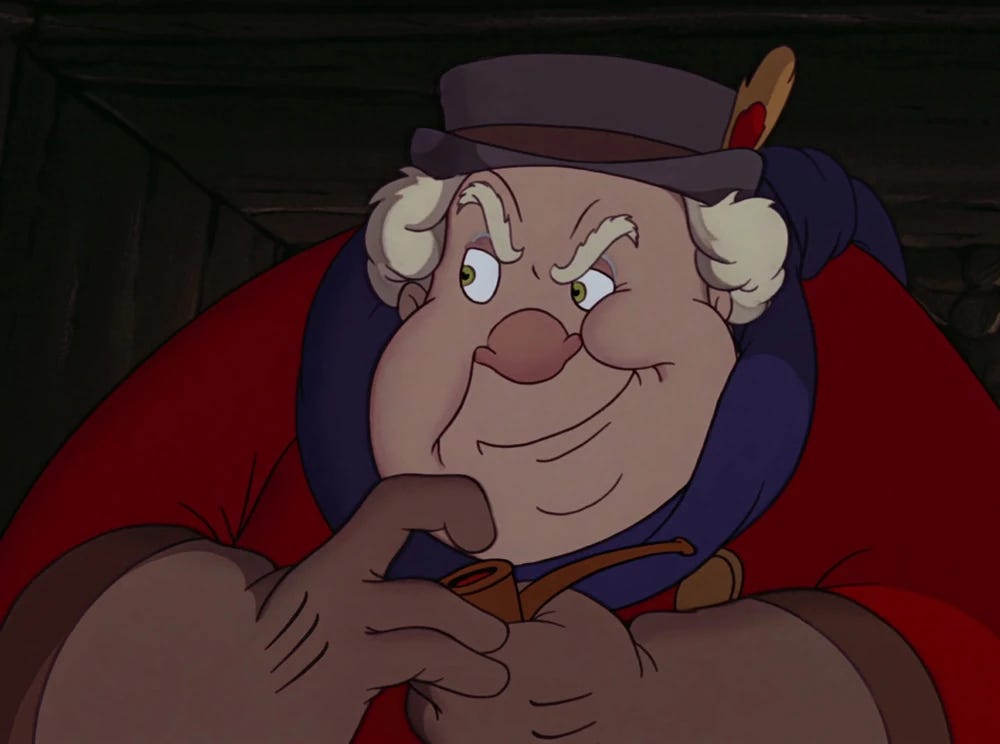
The Coachman in Pinocchio begins as a warm, jovial figure, offering pleasure, freedom, and a shortcut to happiness—like the first high of a drug.
“Wide is the gate and broad is the road that leads to destruction” (Matthew 7:14).
Mephistopheles, the devil in Faust, appears charming, witty, and reasonable—until the bill comes due. Venom offers power and thrills before complete takeover. Addiction begins as solace and escape, then ends in devastation. Ideology promises moral clarity, only to culminate in moral blindness.
8. Invitation Required
“There is sin crouching at your door; it desires to have you, but you must rule over it” (Genesis 4:7).
Possession is not forced; it requires consent.
Across myths and stories, the pattern repeats. Vampires must be invited in. Faust signs away his soul in exchange for power. The threshold is always crossed voluntarily—often through betrayal, sometimes of others, but just as often of one’s own values.
There is always a price of admission.
Why Naming Matters: The Rumpelstiltskin Effect
Addiction loses power when named honestly. Cult spells break when euphemisms fail. Brittle ideologies panic when their Achilles’ heel is exposed. Truth does not negotiate with darkness; it punctures it.
This is the Rumpelstiltskin effect. What remains unnamed retains power; what is named becomes bounded. When the Coachman in Pinocchio is finally called out as someone who turns boys into beasts, the genial mask slips, the spell cracks, and what was hidden is revealed as diabolical. The same principle explains why The Gulag Archipelago proved so devastating. Aleksandr Solzhenitsyn’s masterpiece exposed the mass imprisonment, lies, and terror on which communism depended.
For more recent illustrations, pro-Hamas activists in the West tore down posters of Israeli hostages because they were the movement’s ideological Achilles’ heel—existentially dangerous to the “liberation” fantasy. And the Cass Review performed a similar function for gender ideology by naming outcomes that could no longer be ignored.
In each case, rage, ad hominem attacks, and censorship followed—not because the facts were unclear, but because they were intolerable. This is why exorcism hurts: naming threatens the demon’s survival.

Exorcism and Inoculation
Exorcism is not gentle. Truth drags you through the mud before it sets you free. The possessed must pay a price: loss of identity, loss of community, admission of error.
But inoculation matters even more. It begins with responsibility. When family, friends, or even colleagues depend on you, demons have less room to operate.
Traditional religion can also inoculate, not because it provides certainty, but because it locates evil within, demands truthfulness, and requires epistemic humility—the Socratic awareness of how little one knows.
Above all: do not lie. Lies compound. Small evasions metastasize into total narrative collapse. If you cannot speak the full truth, at least refuse to speak what you know to be false. Under totalitarianism, Solzhenitsyn understood that personal non-participation in lies was the most practical path to liberation.
Conclusion
Demonic possession as I’ve described is not superstition. It is a pattern—a recurring human failure mode that shows up wherever agency is surrendered, truth is subordinated, and short-term relief overrides long-term good.
The good news is that possession does not have to be permanent. Naming begins the undoing. Responsibility restores sovereignty. And truth, painful as it is, remains the oldest and most reliable form of exorcism.
The task, then, is not merely to spot demons in others, but to recognize the early signs in ourselves.
Because the most dangerous possession is the one we never notice.
Mark D’Souza is a Toronto-based physician and author of Lost and Found: How Meaningless Living is Destroying Us and Three Keys to Fix it.
By “Nietzschean superman,” I am referring to Nietzsche’s concept of the Übermensch: an individual who, in the absence of transcendent moral authority, creates his own values and answers only to his own will. In this distorted form, however, the will is no longer sovereign—but commandeered, unaccountable to anything beyond itself.
 | A guest post by
|
Even better if you can get the infected to start to recognize their own infection. As a retired college professor, I am almost universally assumed to be a creature of the far left. I am not. I'm actually fairly liberal in some respects, conservative in others. I used to be a Democrat, until the Democratic Party left me (partly because of the kind of infection D'Souza describes). But because people assume I'm liberal, I can criticize some of the more radical ideas that have infected the left without triggering an explosion. More than once, I've seen the wheels inside the heads of those whose radical ideas I'm criticizing begin to turn. I try to leave it there and let the sane side of the person go to work. This is a process you didn't discuss, that is, when those who are on the same side (or should I say, sane side) can put forth the kind of criticism that would trigger an explosion if it came from those on the "other side". However, it is also true that some are so radicalized that any criticism at all is unacceptable (the focus of your essay), perhaps *especially* if it comes from the same side. This is why, I think, mainstream Democrats seem so reluctant to call out the radicals to their left. They are more terrified of the explosion to their left than they are of criticism from the right.
I have seen this possession in play both at the organizational level (universities, non-profits, professional societies) and in individuals. The author argues that the issue is psychological with no actual "demon" present. I am not so sure that is true. My late father, a very corrupt Muslim, definitely showed all the psychological signs discussed here. The psychiatrists claimed he had a delusional disorder in which he expects everyone else to see and live in the world that he wishes to perceive rather than the one that is. Such disorders, they claim are almost impossible to treat because the delusions are very hard to overcome in the patient. In any case, during the court hearing to decide whether my father was mentally incapacitated and needing to have a guardian imposed something odd occurred. He was sitting with his lawyer and the guardian ad litem as my lawyer, my sister and I testified from our side of the court. He did not appear to be paying attention and his face and expression entirely changed. It was almost as if a mask had slipped off and something entirely different were exposed and looking out from his face without realizing we could see it. Most interestingly, his normally hazel eyes and turned bright blue! I saw this while my sister was speaking on the stand. Later when we could speak, I asked her if she had seen anything odd about our father during the hearing. She affirmed and described what I just relayed about his odd look while I was testifying BEFORE I had said anything about what I had seen. This suggests we were both observing something real. I don't know how a psychological condition could change eye color and cause these effects.
In a different instance my father had cataract surgery and was thus on strong medication which took several hours to wear off. While on the medication he was a pleasant person though a bit fumbly as one might imagine. After the surgery back at his house you could see the medication wearing off. As his normal self reasserted the pleasant person disappeared, his expression changed and he become the toxic person he normally was, literally picking up the phone to call the oil company whose technician had tried unsuccessfully to repair the 45 year old furnace the day before with the intent to get the poor kid fired for what was an impossible task. His normal antisemitism also returned. In this case there was no change in eye color and the medication was likely in play...something not true in the courtroom.
Any thoughts?