

The open letter from University of California (UC) STEM faculty (exposing the profusion of mathematically unprepared UC undergrads and calling for reinstatement of standardized testing) continues to gain traction. It now has over 1500 signatories including 60 STEM department chairs. It has received national press attention, mostly sympathetic. An open letter from over 600 UC non-STEM faculty has chimed in with support. UC administrators now say they will consider restoring the SAT and ACT although they are slow-walking substantive change.
Major media giving the open letter significant coverage include the Wall Street Journal, Washington Post, New York Post, Fox News, NPR, Los Angeles Times and San Francisco Chronicle. The only notable silence has come from the New York Times. It had given the original 2020 UC decision to phase out SAT/ACT requirements much attention, including here, here, and here, topped off with an op-ed by Janet Napolitano, then-UC President, headlined “Go Ahead, California, Get Rid of the SAT”. Now, crickets.
Published criticism of the open letter has been scant. The most prominent is a SF Chronicle op-ed from Jonathan Glater, Law Professor at UC Berkeley. He opposes restoration of the SAT for the reasons claimed when it was dropped: doesn’t address lousy math instruction in K-12, reduces Black and Hispanic admissions, aggravates class inequities, and isn’t a perfect predictor.
The best defense of the open letter has come from one of its first signatories: Svetlana Jitomirskaya, Math Professor at UC Berkeley. Writing in the Free Press, she combines strong data-driven arguments for restoring the SAT with moving accounts of the personal costs for striving students. One of those students is “Diego”, whose background and interests check every box that dropping-the-SAT was intended to support, but whose math skill boils down to memorizing cookbook formulas without understanding rationale or application.
“To succeed now, Diego will need to unlearn these habits and rebuild his mathematical foundation from scratch… I desperately hope he manages to do so. But statistically, the chances are dangerously low…. The probability that he will survive his first Berkeley calculus course, even with a barely passing grade, is 50-50. He will spend his entire college career in a frantic, exhausting game of catch-up, and it is far more likely that he will be forced to change his major—leaving a hardworking young man’s confidence badly shaken, his engineering dreams derailed, and significant public resources wasted.”
Jitomirskaya also noted a perverse correlation baked into UC’s current admissions. “Today, the more successful a public high school is at preparing its students, the lower its graduates’ chances of getting into top UC campuses like Berkeley and San Diego.” Here is a chart she provided, based on analysis by Hart Hornor-Jones.
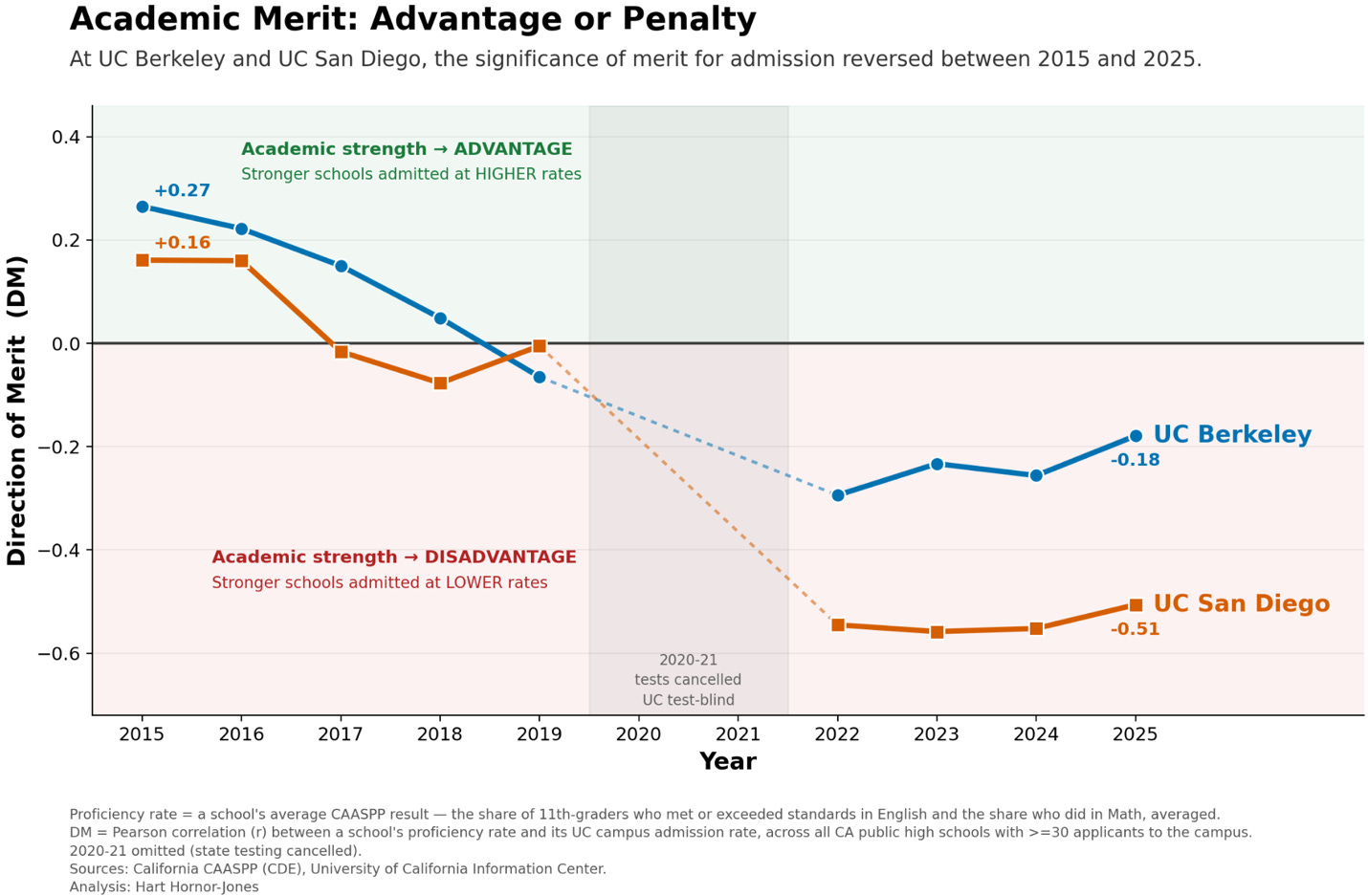
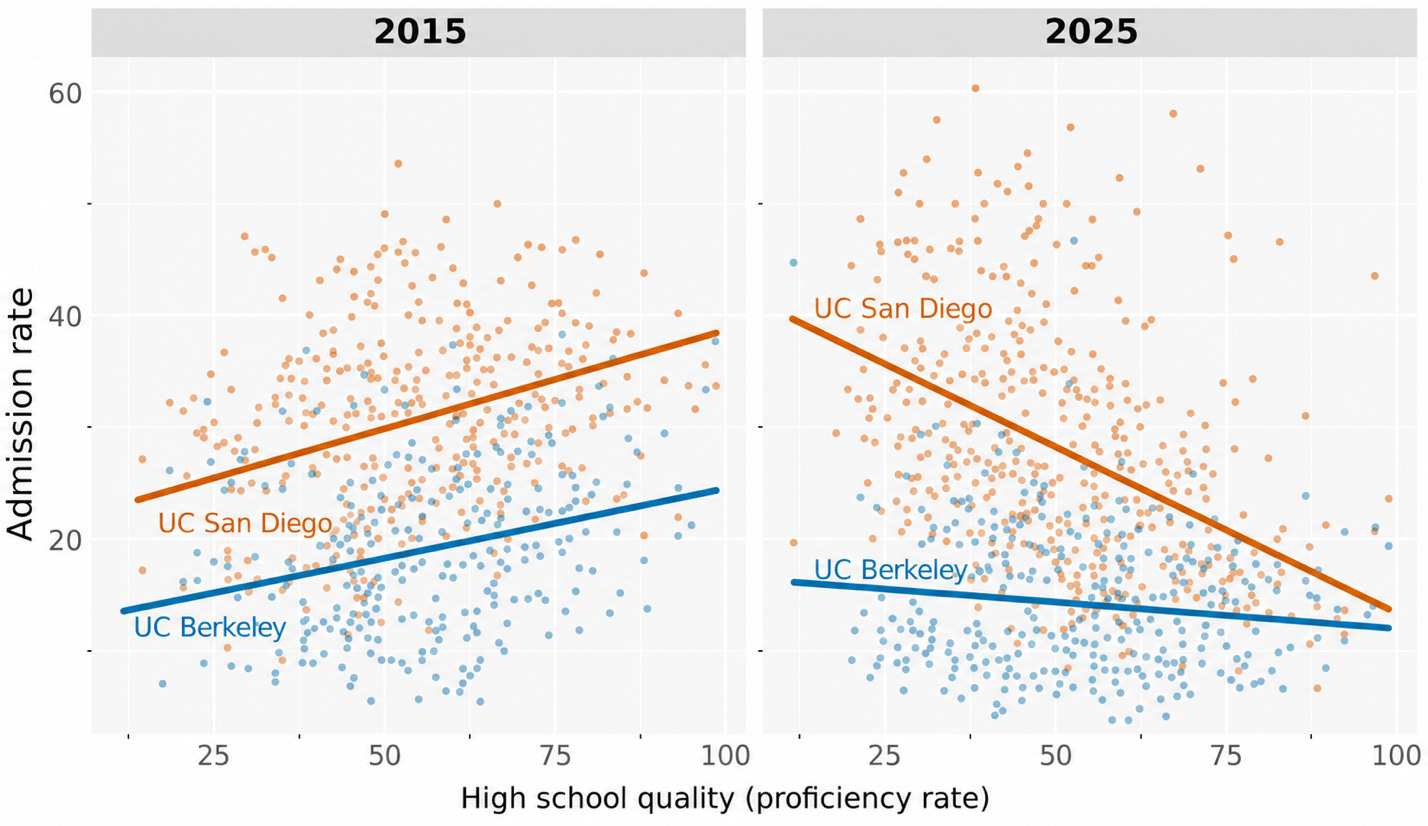
The statistics in that chart might be hard to understand. Jay Tanzman, who analyzed Hornor-Jones’s data independently, summarizes the core finding more succinctly in the chart below. The dots in the scatterplot indicate a high school’s quality and the admission rate for its students to UC San Diego or Berkeley. The straight lines present the main trends. In 2015, the better the school, the higher its UC acceptance rate. In 2025, the better the school, the lower its acceptance rate. This change helped drive the nearly thirtyfold increase since 2020 in first-year students with math skills below high-school level, and with one in twelve new students falling below middle school levels. (See the STEM faculty open letter and its links for further detail). UCSD deserves special recognition for its seeming antipathy to good preparation.
Of course, defenders of current UC policy will deny antipathy. They just want to reward effort to get a high GPA, without penalty for low standards rooted in centuries of oppression. But this misses some key truths:
· A high GPA disconnected from standards is worthless, and even worse than worthless when it misleads students like Diego about what learning truly is.
· Families seeking the best education for their bright kids often make considerable sacrifices to live near good schools.
· Discrimination against those schools hurts rich kids little and poorer students a lot, since the latter can less easily afford private tuition elsewhere.
· The disincentives for high standards hurt the disadvantaged most and will be blasted by future scholars as tools of oppression.
What most amazes about the UC Regents is their utter lack of self-awareness. I can appreciate their shame at quality differentials across K-12 schools, their concerns about disparate impact on darker-skin persuasions, their ostensible dedication to DEI and their boldness in experimentation. But then why not tackle it at the most hierarchical educational institution in their state with intentional quality differentials and grossly disparate impacts? That institution is California’s public higher education system, with UC as the top tier and substantial internal sorting within. Why not start by removing campus names from UC diplomas and equalizing Berkeley with UC Merced? Why not scrub courses and majors from transcripts so that only grades and GPAs remain? Once UC is homogenized, how about folding it into the California State system, so that top Dominguez Hills and Humboldt grads get the elite stature they deserve? And then the piece de resistance: merging all public California universities into its Community Colleges, with their low tuition and open admissions.
The double edge of the affirmative action sword is that it harms the very people it was intended to assist by giving them a false impression of their true skills, leading them to underperform and justify the very claims of "inferiority" that they seek to negate on the one hand while calling into question the qualifications of members of those groups who truly did rise by merit.
There is one big problem with this approach to the issue however. The inadequate teaching in our public schools arises, in great part, because of the conduct of universities themselves. It is universities that train the nation's teachers. Not only is it education departs that have watered down the curriculum and filled its with social engineering drivel, the STEM departments themselves are DIRECTLY to blame. It is the STEM departments that treat courses for pre-service teachers as unimportant service courses from which they seek to extract resources in terms of larger class sizes and use of untenured/adjunct faculty without proper support so that they can have smaller classes and course releases to support...wait for it...RESEARCH!
Example: My job at MSU-Mankato was specifically created by the legislature's creation of a requirement that all pre-service teachers have increased and improved course work in science. Similar legislation applied in math. The faculty lines were placed in the STEM departments to insure that the pre-service teachers were given instruction by serious experts in the discipline. Unfortunately, those faculty were immediately undermined by administrative pillaging of resources. The Dean summed up his opinion repeatedly thus, "They're only going to be teachers, what do they need to know?" to justify increasing class sizes, reducing contact time and adding other duties to the faculty so he could move resources into areas the legislature had NOT chosen to fund including course releases for faculty to do inconsequential research.
If you really wish to improve teaching in the public schools, you need to hold universities responsible for the teachers they produce....perhaps by withholding tenure lines and overhead from research for the failure of their teachers to produce quality outcomes.
good article. The angle for next news article needs to be finding and featuring the faculty and administrators who are pushing back against testing and are blocking it. name them and air their arguments or lack thereof