

Public confidence in higher education has dropped sharply in recent years. The main contributors appear to be a lack of ideological diversity in colleges and universities, constraints on open inquiry, and the erosion of empirical standards in parts of the academy. Here I describe two college-sponsored events dealing with “fat studies”—one in late 2024 and another in April 2026—which I attended out of simple curiosity about this academic discipline. Here is an account of the claims made at these events taken from my notes.
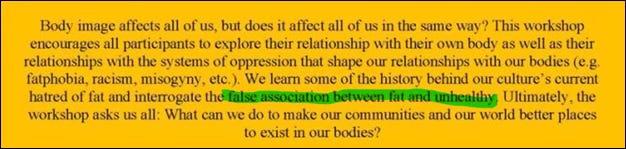
My biology and pre-med students were particularly intrigued by a Gender Studies talk that promised to “interrogate the false association between fat and unhealthiness” (see workshop description below). Being new to “fat studies,” I was curious to see more about this claim. Two years later, I decided to attend a second event, wondering whether the messaging had shifted in the age of Ozempic and following the 2024 elections. What I encountered may sound satirical, but it was not. The speakers were dead serious. I have kept the speakers’ names private; my aim is not to mock individuals but rather to show the persistence of anti-scientific perspectives in this field at my college. Both cases exemplify the ideological erosion of science that has led Americans to lose confidence in their colleges and universities.
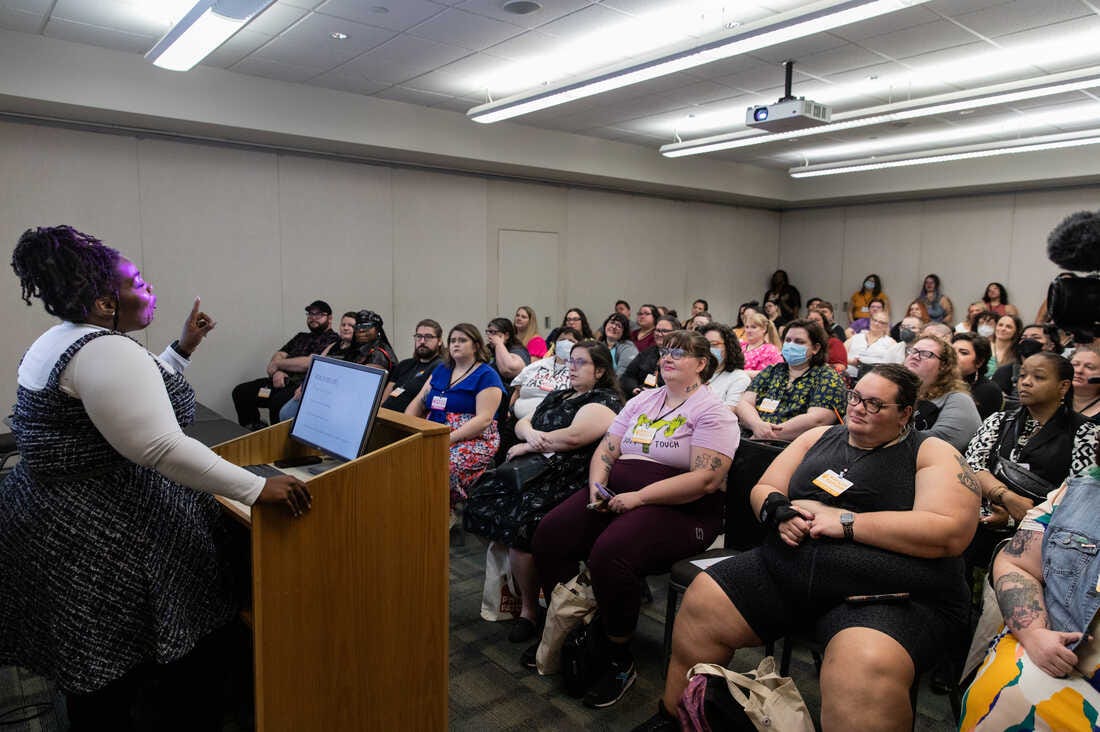
In the first talk, sponsored by Women and Gender Studies, DEI initiatives, and American Studies, the audience was expected to participate, but the auditorium was nearly empty—most likely because the event fell on the day before Thanksgiving break. There were only three biology students (myself included), five gender-studies students, and a handful of professors and staff.
The event opened with identity: the speaker stated that she identified as “fat, white, and used they/them pronouns.” I learned that “obese,” “BMI,” and “weight” are seen as pejorative terms that should never be used. She added that it was bigoted to suggest that obesity is mainly a lower-socioeconomic-class issue tied to the inability to afford healthy food. This view, we were told, wrongly assumes that the foods fat people eat are unhealthy and that being fat is bad. We were then asked to “pair-share” with colleagues in the room, about our emotions and body image and recount when we first developed the idea that being fat is bad.
The speaker next wrote down the roots of “fatphobia” on the board (see figure below). Body mass index (BMI), she said, was invented to discriminate against fat people, and its origins lie in capitalism. White people were blamed for creating the notion that “whites are thin” as a way of oppressing black people. Medicine was described as another culprit: there is no such thing, we were told, as a “healthy diet.” Instead, “a healthy diet is what you like to eat.” Further, children were described as having an innate ability to sense how much food and what kind of food they need. The research on whether processed foods affect health was described as unclear. What ultimately harms fat people, the speaker claimed, is oppression and dieting. Anti-fatness, we learned, goes hand in hand with every other system of oppression: “Whenever we are talking about anti-fatness, we are also talking about white supremacy”.
The medical system was described as actively discriminatory: “When fat people come into the hospital with cancer, they are told to lose weight before being screened,” and waiting-room chairs are too small. These forms of discrimination, rather than physiology itself, were said to explain the observed correlations between fatness and health problems.

At this point people began asking questions. I inquired about animal studies: surely, fat rats do not die at higher rates because of fatphobia? The reply was nonsensical: “everyone knows fat is protective in rats.” A student noted the well-documented correlation between cardiovascular disease and fatness. The speaker asked for references. When he responded that there were thousands, she reminded the room that “correlation is not causation” and that people die from oppression and from being forced into diets.
A gender-studies student came to the speaker’s help, shouting at the student who asked the question: “Are you deaf? Are you not listening? Shut up and listen!” The speaker proceeded to write the word “Science” on the board under the heading “institutional problems.” She later stated that genetics, not food consumption, explains body weight: “People can be 15 pounds above or below their genetic makeup and no more or less.” This was another nonsensical idea, easily contradicted by looking at the recent past: just a couple generations ago people of every demographic group were skinnier than they are today, and the genetics of those groups could not have changed much in such a short time. The exchange illustrated how data-based questions were repositioned from a legitimate inquiry to an expression of overt bigotry.
I was struck by the speaker’s anti-scientific tone, the reflexive dismissal of evidence, and the flat-out distortion of established findings. I was left wondering how much of this perspective is taught in college classes, and how many students exposed to these distortions think that they can push back without being labeled bigots.
My second encounter with “fat-studies,” in April 2026, was a talk sponsored by the Dively Fund (created to support LGBTQ events, although the talk contained almost no LGBTQ content). It was billed as “A conversation on Blackness, Queerness, Gender, Fatness, Disabilities and Their Intersections.” Attendance here was higher—roughly 20 students plus three adults, myself included.
As before, I approached the talk with genuine curiosity; I wondered whether this corner of “studies” would adapt or remain unchanged in the era of Ozempic and recent shifts in public discussions of obesity.
Some of the speaker’s themes overlapped with those of the first event, including the claim that “good and healthy” food is simply whatever you like to eat. There was also a brief and negative reference to Ozempic: “GLP-1s are terrible because they make fat people appear suicidal for not wanting to lose weight.”
The rest of the talk took a very different direction. Because the content was somewhat disjointed, I will share some direct quotes. We were told that “fatness was invented to prepare individuals for war by the Nazis” (though the speaker later added that it was invented by the slave trade). “Body fascism is now practiced in France, USA, Israel and Britain.” “The ideal body is militarized to displace and violate black people.” “Fat fascism is about the subjugation of the slave and slave-adjacent (Palestinians).” “The Jewish body is imposed on Palestinians by starvation and the denial of junk food [which is the kind of food they would like to eat].” “This subjugation did not begin with Trump; it began with democracy and those elected to represent society.” Michelle Obama’s healthy-lunch initiatives were cited as a pre-Trump example. “Fatphobia is the making of the slave.” “Fatness has been projected onto African flesh.” “You are not men or women; you are just fat or thin in a ship hold” (referring to slave ships). “After Nazis, COVID, HIV, [and] slaves, one must prove they are fit and not crippled—this is how ableism started.” “Nationalists don’t believe cripples have the right to exist.” “Freedom requires the death of our desires.” “Our love keeps us in shackles. We need to divest from love to bring the revolution” (though the speaker added that his love for his people was too strong to relinquish).
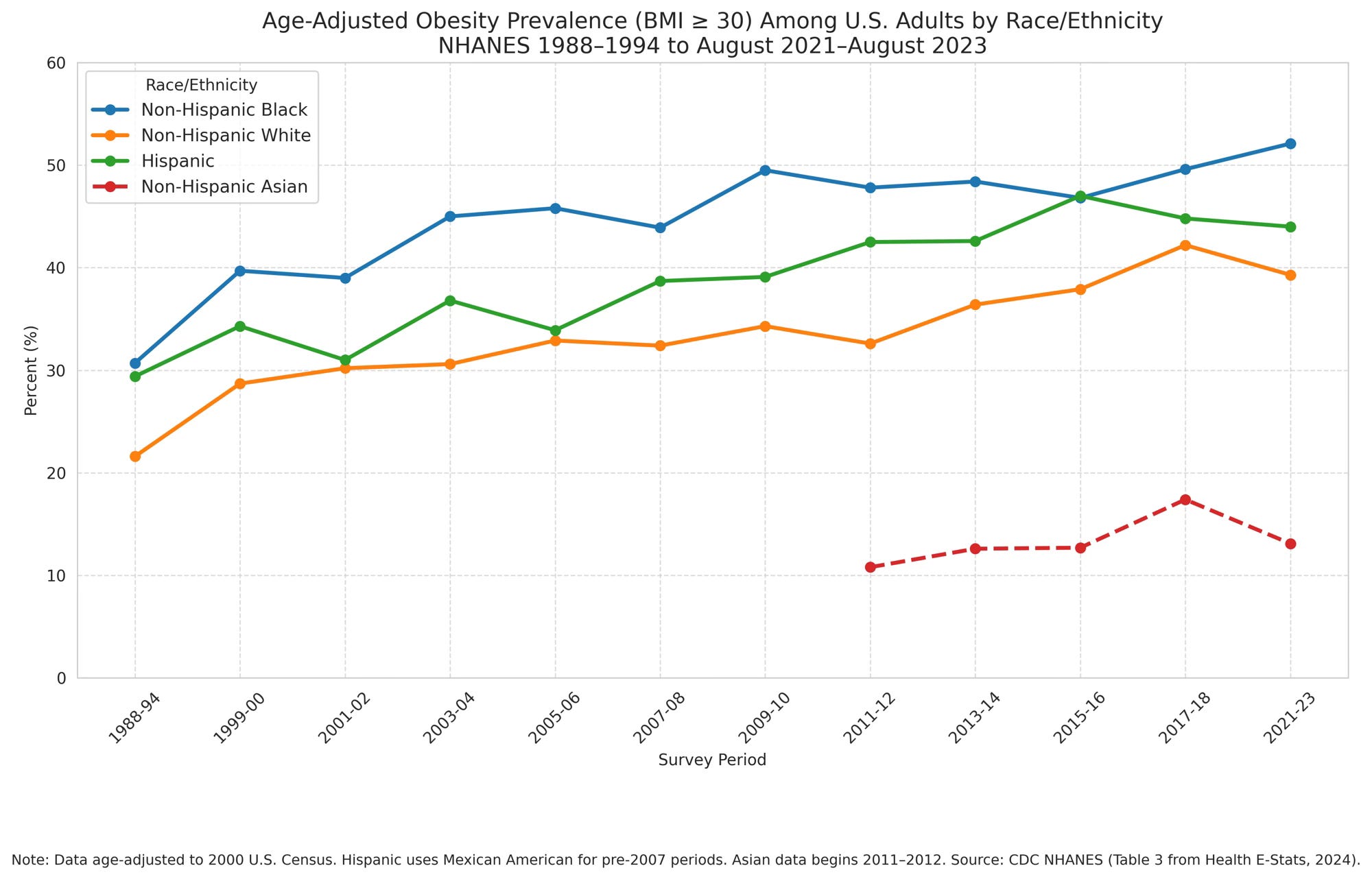
These two events were separated in time by the advent of GLP-1 receptor agonists, by shifts in U.S. obesity trends, and by decreasing public trust in academia. With all these changes, it is surprising that the core messages did not differ. This pattern shows that certain postmodern ideas are still firmly rooted in parts of higher education. In both sessions, accepted physiological results from epidemiology, animal models, and randomized controlled trials were largely recast as artifacts of oppression. Concepts central to medicine—BMI, or the existence of healthy versus less healthy dietary patterns—might not be flawless metrics, but they are certainly not ideological inventions motivated by fatphobia.
When college-sponsored events list ‘Science’ itself as an institutional problem, they expose a deep split in how people view knowledge and truth—and in what these events are really selling. The talks confirmed this split: questions were met not with counter-evidence but with accusations of bigotry, rote reminders that ‘correlation is not causation,’ or outright commands to stop speaking—along with preposterous assertions that flouted basic standards of evidence. Such tactics do more than mislead audiences; by violating the very norms of reason and evidence that people have long accepted as good science, they accelerate the erosion of public trust in both science and higher education.
Editor’s note: As documented in these pages, this postmodern nonsense has spread into STEMM. For example, the Inclusivity Style Guide of the American Chemical Society asks authors to avoid such phrases as “people affected by obesity,” “obesity is a public health crisis,” and “healthy-weight participants were more likely to experience this effect than the participants at an unhealthy weight.” A pamphlet published by the University of Illinois Chicago School of Public Health claims that public health anti-obesity campaigns are an example of “fatphobia,” that public health’s “focus on body size is rooted in racism,” that “higher weight is not causal to worse health outcomes,” and that “focusing on weight ignores systematic injustices.” And then people are surprised by the loss of public trust in science and academia…
 | A guest post by
|
This is actually a great quote: “Freedom requires the death of our desires.” For example, we can free ourselves from slavery to fancy food through self-denial!
Wait. I'm so confused right now. Was is 1. the slave trade, 2. the Nazis or 3. the creation of the State of Israel?! Events 2 and 3 are somewhat self contradicting and are separated from event 1 by at least a century and half the world. Besides, photos and portraits from the time period show that none of the parties involved is/was particularly fat or skinny. Well, except the Jews at the Nazi camps...
Is this what she meant by "the Jewish body"? Someone help me out here.