
The New York Times, the high church of political correctness, has conceded the waning appeal of one of its cardinal doctrines: the imminent risk of climate disaster. John Cochrane recounts the grudging admission and brings in testimony from Bjorn Lomborg and Steve Koonin, who have long warned against Doomsday forecasts. While none of these critics deny climate change or anthropogenic drivers, they challenge the exaggeration of foreseeable impact and the excess priority given to countering it. This essay complements their analysis by reviewing the last three decades of high-profile international campaigns to save the world from climate disaster. These campaigns were dazzlingly ineffective, except as fear-mongering, virtue-signaling charades. Shamefully, the costs fell largely on the world’s poorest people, the very group that climate activists vow most to save. Real progress hinges on cost-effective engineering and frank discussion of tradeoffs.
Tipping Point Terror
The single biggest fear about climate change is founded on two notions. First, that global warming induced by anthropogenic greenhouse gas emissions has been fast by most geological standards. Second, that feedback loops that temper gradual warming might be overwhelmed by fast warming. The combination could potentially reach a tipping point where oceans expel stored carbon dioxide, ice packs melt, forest fires range around the globe and human civilization collapses. Although the risk might be miniscule, the very portrayal of the horrors warns against taking it. The argument is basically an updated version of Pascal’s wager, where belief in God is justified by even a miniscule risk of an eternity in hell for disbelief.
According to ChatGPT, “the ‘tipping-point/catastrophe’ frame is very common in the direct-action wing of the climate movement…. Activists catalyzed formal ‘climate emergency’ declarations by ~2,300 jurisdictions in ~40 countries, covering ~1 billion people”. Various group names speak in this register: Extinction Rebellion, Last Generation, Declare Emergency, Just Stop Oil, Stop Ecocide International, End Fossil 2030. So does Scientist Rebellion. which claims over a thousand members.
While catastrophists seem to grossly exaggerate the risks, I don’t begrudge their rights to vehemently disagree and to proselytize for converts. The charade I see concerns their prioritized actions. All of them are extremely costly, highly disruptive, and easily undermined by countries that dissent. Yet there is a much simpler solution that is comparatively cheap and quick and doesn’t require global coordination. It’s called global dimming.
Global dimming—not to be confused with global dhimmi-ing or global dimwitting, two trends I don’t approve—concerns injection of aerosols into the stratosphere to partially block sunlight. This was first suggested in 1971 by Soviet geophysicist Mikhail Budyko, one of the founders of physical climatology and highly respected even in alarmist circles. Paul Crutzen revived the idea in 2006. Volcano eruptions like Mount Pinatubo in 1991 confirm the quick and massive effect.
The cheapest and best-studied aerosol is sulfate. Delivery costs were estimated in 2012 at less than $10 billion per year for an 0.5°C cooling, noticeable within a year, which no other proposal approaches. Review in 2018 amended some details but confirmed the feasibility and low cost. Furthermore, a small coalition of willing governments could implement this on its own, even if other governments complain, as there is no relevant international regulation.
Like any other proposal, there are drawbacks and uncertainties, and no one denies the need for smaller local tests before large-scale implementation. However, none of the potential downsides rival the feared mass extinction from global warming. Nevertheless, a geoengineering field trial in 2012 was abandoned after protests, and Nature magazine—despite years of peak worry about global warming—refused to defend the geoengineers. It insisted that “regulation in these cutting-edge and controversial areas needs to be working before the experiments begin”. Another proposed experiment was abandoned by Harvard in 2024.
Yet relatively few climate activists endorse aerosol experiments; more are in the forefront of opposition. Here is a site dedicated to the “international non-use of solar engineering”. Its open letter to “prevent the normalization of solar geoengineering as a climate policy option” and “restrict the development of solar geoengineering technologies at planetary scale” has been signed by over 600 environmentalist scholars.
Why do people claiming extinction-level emergencies refuse to test the quickest, cheapest, and easiest method to address it and try to ban others from trying? Here are ChatGPT’s main explanations, couched as prudence and climate justice:
Most activists believe that “even discussion of sulfate aerosol injection can undercut political will for cutting fossil fuels”.
It would build precedent for making geoengineering decisions without international agreement.
It “could redistribute climate risk (e.g., monsoon changes) without [activist] consent and could be unilateral in practice”.
Implementation is substantially more expensive than it looks, since “the true costs include governance, monitoring, verification, and risk management across borders”.
“If stopped abruptly, aerosol injection risks ‘termination shock’—a rapid rebound warming.”
My reading is blunter. What evidently worries activists most is that the tests might indeed work quickly, cheaply, and easily. Why? Because this would permanently reduce pressure for mandatory cutbacks in fossil fuels, expanded UN-style governance, funding for armies of bureaucratic regulators, and their own employment too. Since there’s not a snowball’s chance in hell of these aims being implemented at large scale soon, the tipping point always needs to be 10-20 years away.
Granted, global dimming is bound to have negative side effects, they won’t be evenly distributed, and some regions will doubtless lose more than they gain. This is bound to induce outrage, huge demands for reparations, and major misgivings. However, that is true of every major measure to reverse global warming. Extra CO2 boosts crop productivity a lot, and that’s especially important to the poorest people in the world who spend much of their income on food. World Bank simulations suggest that each 1% increase in world food prices pushes about 10 million people into extreme poverty. Judging from benchmark estimates of productivity changes and elasticities of supply and demand, reversing the last half-century of CO2 accumulation would likely raise food prices by over 5%. Yet few if any climate activists acknowledge the downside, and none would ban fossil fuel shutdowns until that downside is addressed.
Kyoto Results
For most of the past three decades, the centerpiece of global emissions control was the Kyoto Protocol. The treaty, signed with great fanfare in 1997, sought to codify a 1992 UN agreement to reduce emissions of CO2 and other greenhouse gases. The US was the only notable country not to sign and was widely condemned for its refusal. However, most Kyoto restrictions were mild. It did not even take effect until 2005. All less developed countries were exempted. Countries in the former Soviet bloc were credited with CO2 savings from shutdowns 10-15 years prior. [Those factories were enormous CO2 belchers, partly because they were supplied with oil and coal dirt cheap and partly because nothing overlooks environmental degradation more than higher socialist aims. Kyoto gave the EU a good deal by moving the benchmark start date back to 1990 or earlier.] Since countries agreeing to restrictions already controlled their firm-level pollution more than the countries exempted, Kyoto de facto encouraged the transfer of production to dirtier, higher-emitting factories.
The chart below, compiled by ChatGPT, shows what happened. The dotted line shows the projected 1% growth in the 1990s assuming business as usual. The green line below it projects Kyoto’s anticipated 1-2% savings by 2010—just a drop in the bucket of what climate activists thought was needed. The black line indicates actual levels, which rose by nearly 40%.
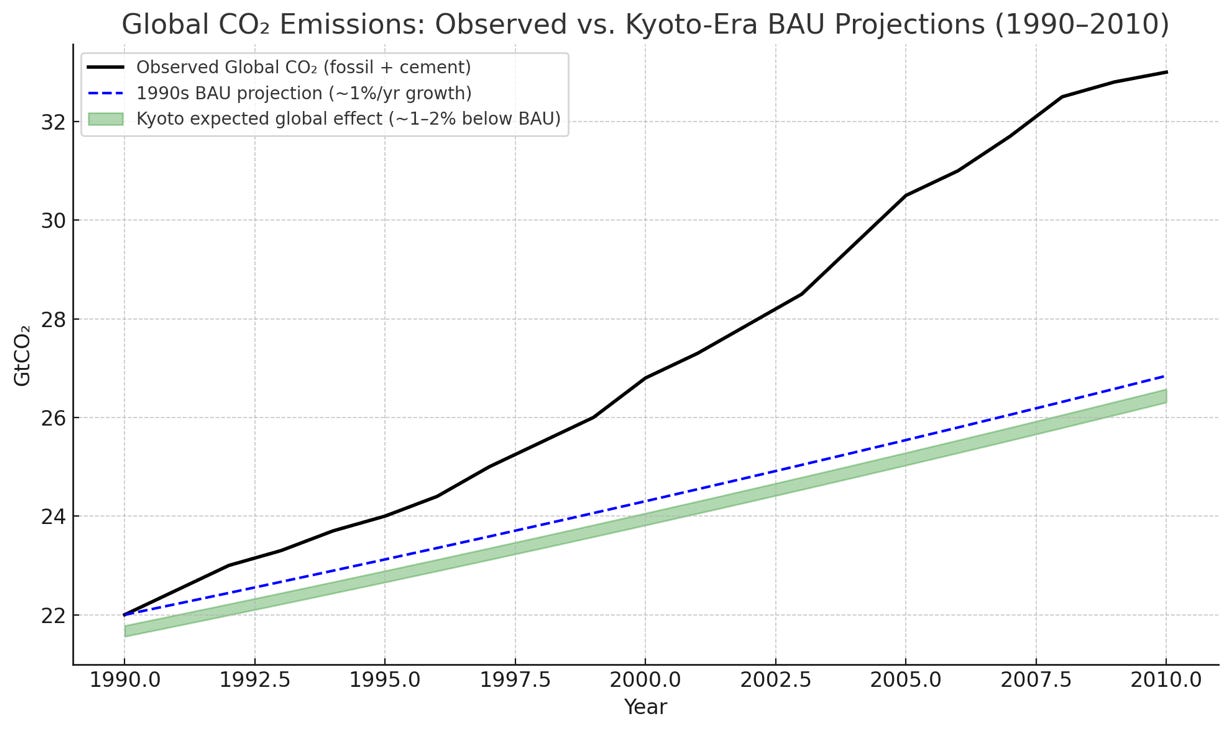
Kyoto didn’t even reduce the CO2 burdens from developed country signatories. The most Kyoto-supportive account, based on counterfactuals, estimates a cumulative 10 gigaton reduction in their CO2 emissions, which at best would reduce atmospheric CO2 by 0.3%. But half of that stemmed from post-Soviet shutdowns that would have occurred anyway and the rest was fully offset by the rise in carbon-embedded imports. An alternative project-based accounting deflates the headline 10 gigaton reduction to 1 gigaton. Ironically, the non-signatory US, the chief bogeyman of Kyoto, outshone others in stabilization, partly due to shale gas production, much deplored by environmentalists.
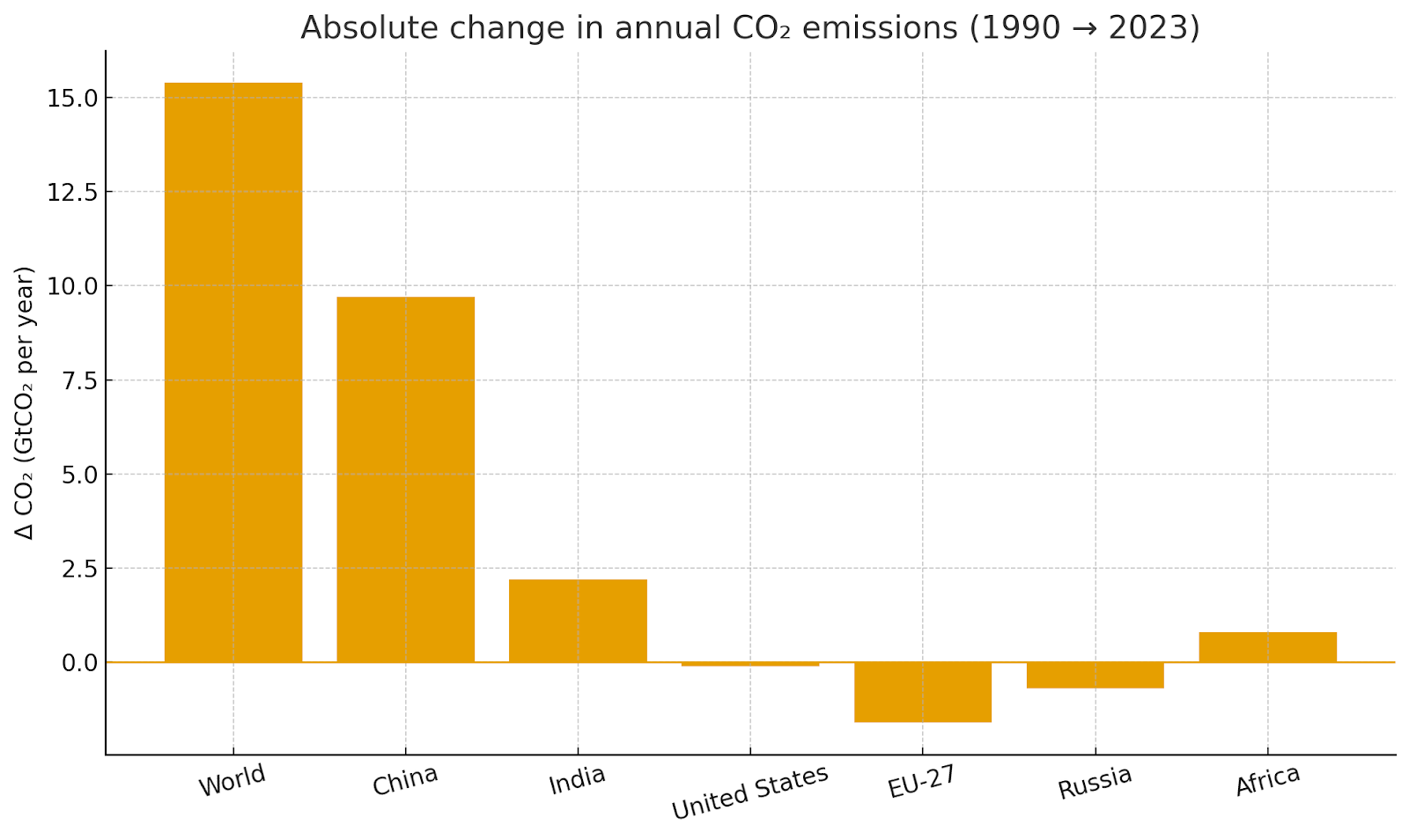
The Kyoto Protocol’s main legacy was the extra impetus to production shifts to the developing world. However, the effect was highly unequal. China, India, and Brazil benefited greatly, as they had the capital and institutional backing to expand investment in power generated by fossil fuels. In contrast, poorer countries dependent on international aid saw funding for fossil fuel projects dry up. With aid for hydropower projects already limited on conservation grounds, those countries—particularly in sub-Saharan Africa, were forced to rely on smaller and costlier renewable energy projects, whose output is far less reliable and needs to be backstopped with other sources. China’s growing influence in poorer countries partly reflects its willingness to finance hydropower and fossil fuel projects there.
Subsequent Posturing
Let’s not blame the Kyoto Protocol too much. In fact, all efforts to curb CO2 emissions by proclamation are doomed from the start. Here’s why:
Most of the world wants to greatly increase per capita GDP, even if pampered elites do not.
Energy use is highly correlated with GDP. The elasticity of energy with respect to GDP is particularly high in poor countries, since people ascending into the lower middle class prize more animal protein and motorized transport, both of which are energy intensive.
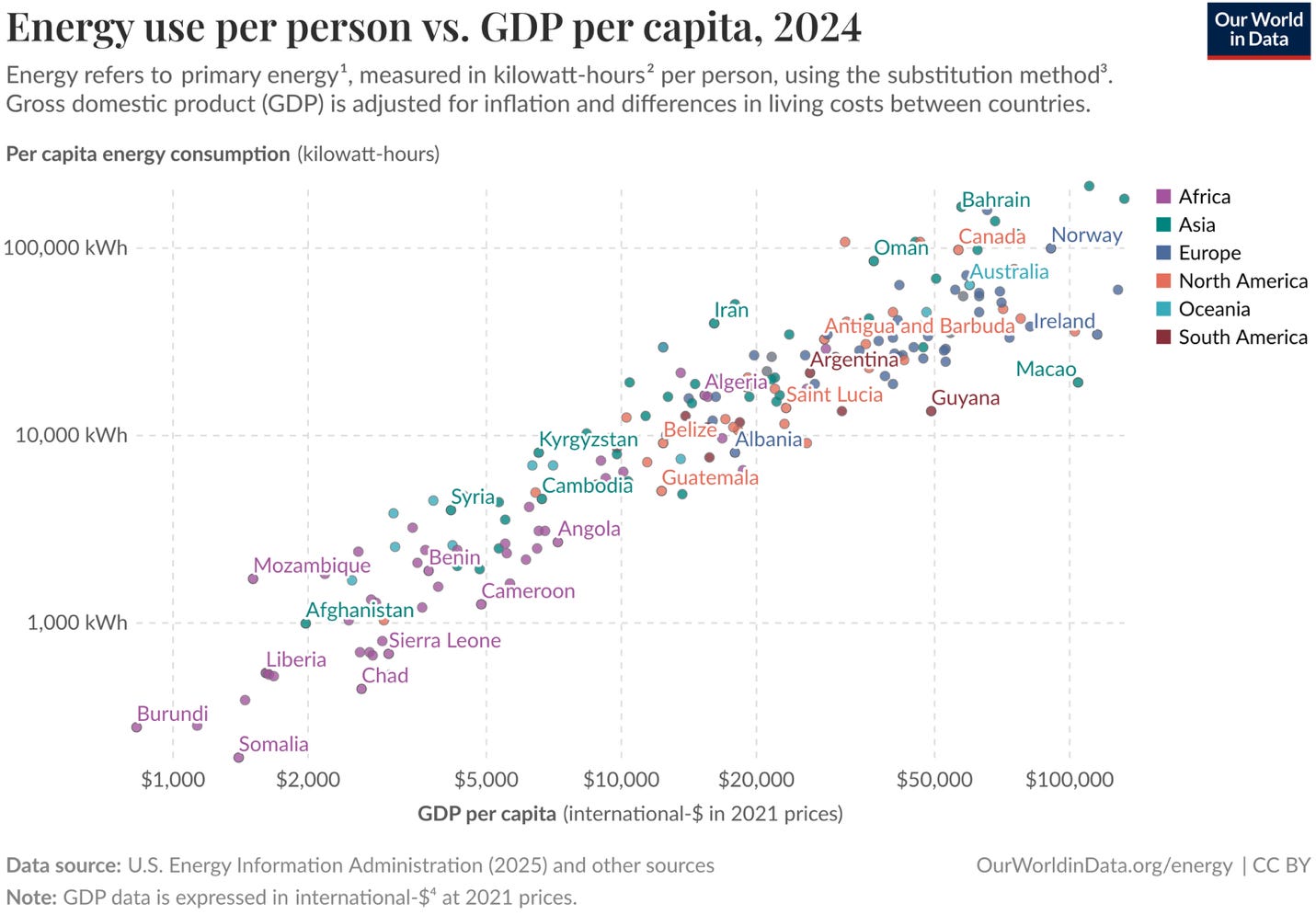
Energy generation is the main source of CO2 emission and is highly correlated with GDP. Progress in decarbonization depends mainly on technological improvements that cannot be simply proclaimed.
While explicit or implicit carbon taxes help incentivize decarbonization, the tax rates must be relatively uniform worldwide to be effective long-term.
Global taxes raise huge questions of ownership rights in air, precise measures of liability, credits for forests and other carbon sinks, credits for technological innovations shared by all, and reparations or redistribution.
Free riding is terribly easy, so the strongest demand for regulation comes from would-be global governors. Since the latter lack military power, they continually jockey for support from various countries, usually through exemptions that undermine the ostensible aims.
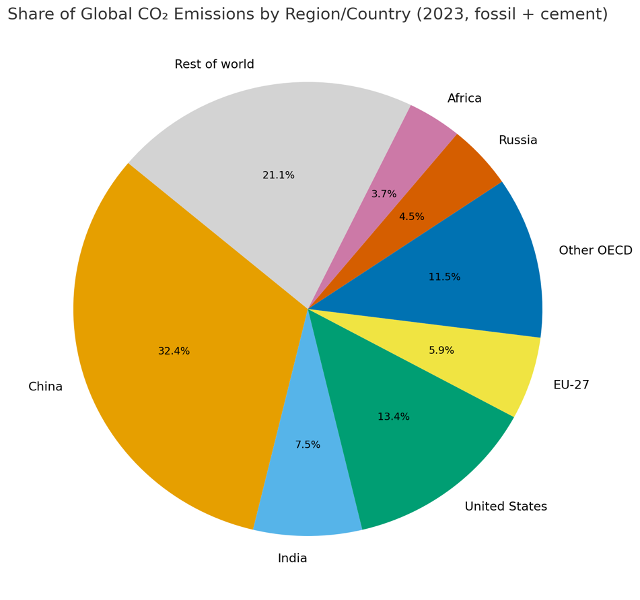
China’s emissions now exceed the OECD’s, rendering its exemption from regulation ludicrous. Yet as a manufacturing-intensive latecomer under strict one-party control, China has no incentive to accept severe restrictions and bends little to outside pressure. Consequently, Kyoto was bound to peter out. Subsequent intergovernmental discussions on climate change have taken two main forms. One looks for something small and doable. The other sets ambitious new targets but defers them to 2100, far too long to worry about mechanisms for compliance or accountability for failure.
Reawakening to Reality
The international deferral of key targets to 2100 was bound to isolate the imminent-disaster crowd. The last world leader clinging to urgency was Mark Carney. As central banker, he had urged all lenders to keep climate risks in mind. He ardently endorsed a high carbon tax in Canada. Yet on campaigning for Prime Minister, he acknowledged that it had become “too divisive”, and he repealed the tax on his first day in office.
While extinction fears are far from extinct, their pull on the public is shrinking. When Arctic sea ice exceeds 1.3 million square miles for 11 straight years after the 2014 deadline projected by Al Gore for its disappearance, people stop losing sleep over polar bears. The rolling horizon of disaster reassures by its continued roll. And so many fresh causes for outrage have sprouted that even Greta Thunberg, the Joan d’Arc of climate warriors, shifted focus.
To activists, these shifts are merely tactical; they are confident climate will return to the fore. But I see signs of a long-term shift, thanks to AI:
With AI development considered vital to both national security and business organization, and with hundreds of billions of dollars invested in data centers, US policymakers’ core concerns about energy have flipped. For three decades they focused on how to operate a relatively stable power grid with fewer emissions. Now they need to generate a lot more power soon. Yes, with few emissions too, but without the luxury of grandstanding over means.
Reawakening to reality is bound to favor engineers over ideologues, producers over regulators, and pragmatists over catastrophists. This does not mean that climate risks don’t matter. Indeed, some are bound to heighten. But I am confident that we will see more discussions in the spirit of Lomborg, Koonin, and Shellenberger and fewer in the spirit of the Inquisition.
Hallelujah! As a climate scientist, I have always been skeptical of the alarmist views (and have gotten into trouble because of that). If the NYT is now backing down, maybe the drivers of this nonsense are finally listening to the louder (than mine) voices of reason. And I was struck by a comment early in the essay. So many responses to luxury beliefs (of which climate alarmism was one) do end up hurting the very people they purport to help.
AGW was always pseudoscience. Global dimming is also nonsense.
Man adapts. Long term nuclear is the answer, but there’s no rush.