
A Thousand Faces, One Journey
A personal reflection on Joseph Campbell’s The Hero with a Thousand Faces

Are you a Star Wars fan? The Lord of the Rings? Batman? Harry Potter?
If so, you already know Joseph Campbell—even if you’ve never read him.
Published in 1949, The Hero with a Thousand Faces is Campbell’s comparative study of myth across cultures and centuries. His central claim is deceptively simple: beneath the surface differences of myths and religions lies a single recurring pattern—the monomyth, or the hero’s journey. It is the same story told a thousand different ways because it is, fundamentally, the story of human psychological development.
This is not only a grand or cinematic pattern. The hero’s journey can unfold in a single year—or a single morning: a commitment to marriage, or leaving the house for the gym when comfort begs you not to.
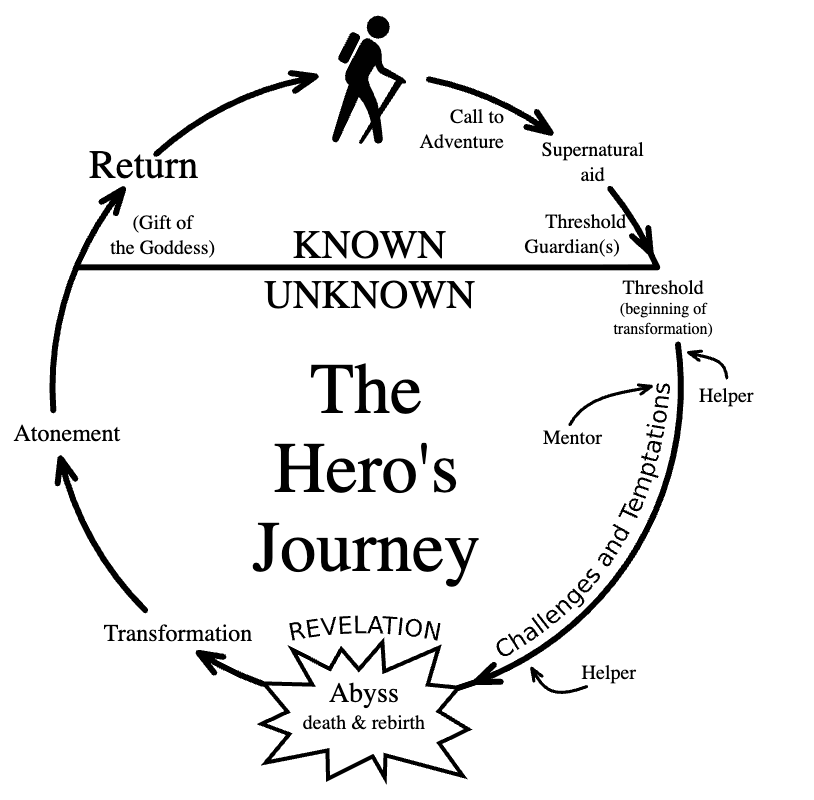
Campbell distilled this journey into three broad movements—separation, initiation, and return—a magnified map of the rites of passage we all undergo. What follows are the key stages within this journey that struck me most powerfully.
Refusal of the Call
Early in every hero’s journey comes a summons—a call to adventure. And almost just as reliably, it is refused.
“The myths and folk tales of the whole world make clear that the refusal is essentially a refusal to give up what one takes to be one’s own interest.”
The refusal is not cowardice so much as attachment: to one’s current identity, status, routines, or imagined security. Campbell warns that this refusal leads not to safety, but to stagnation.
Scripture is full of this motif. Abraham hesitates. Moses protests. Jonah quite literally runs the other way. And in ordinary life, we do the same. We ignore the quiet inner voice telling us we need a job change, a hard conversation, or a risky leap—often multiple times—before we finally listen.
Refusal feels prudent. In retrospect, it is usually the moment life begins to shrink.
Supernatural Aid
When the hero finally commits, help appears. Sometimes it looks like Gandalf. More often, it looks mundane: a chance meeting, an unexpected opening, a door you didn’t know existed suddenly swinging open. Campbell calls this supernatural aid, but in real life it often feels like improbable timing—or grace. The key is that the help arrives after commitment, not before.
Crossing the First Threshold
“The crossing of the threshold is the point of no return… Beyond it lies darkness, the unknown, and danger; yet it is also the source of what the hero seeks.”
Crossing this threshold requires a leap of faith. There is no guarantee of success, and no way back to who you were. I once quit a job I knew I had to leave before having anything else lined up. It felt reckless. Within a month, a far better opportunity appeared—one I could not have reached without first stepping into uncertainty
Campbell reminds us that threshold guardians exist for a reason: they test readiness. Gargoyles at temple gates, dragons at cave mouths, Heimdall in Marvel’s Thor at the entrance to Asgard—they are not gratuitous cruelty. They ensure that only those prepared for transformation proceed.
The MCAT—Medical College Admission Test—is such a guardian. So are licensing exams, auditions, and difficult initiations of every kind. If you cannot pass the test, you are not yet ready for the journey beyond it. Which is why the lowering of admissions standards in the name of diversity risks ushering people into paths for which they are not yet prepared—setting them up for avoidable struggle and failure.
Belly of the Whale
After the threshold comes something darker. The hero is swallowed.
This stage symbolizes descent rather than advance—an apparent annihilation that is in fact gestation. Jonah in the whale. Christ in the tomb. Hercules entering the sea monster to destroy it from within. Aslan entering death itself to break it. The old self dies so that a new one can be born.
“The hero, instead of conquering or conciliating the power of the threshold, is swallowed into the unknown, and would appear to have died.”
In life, this feels exactly as unpleasant as it sounds. A period between jobs. A collapse of certainty. A loss of identity. It can feel like death.
But without this phase, resurrection is cheap. As even Batman reminds us, the night is always darkest before the dawn.
Atonement with the Father
In Campbell’s schema, the “Father” is not merely a parent, but the embodiment of authority, tradition, and ultimate judgment. The hero must confront this force not simply to overthrow it, but to reconcile with it—moving from adolescent rebellion to mature integration, recognizing that tradition is neither entirely wrong nor wholly sufficient, but something to be refined: carrying forward what endures while discarding what no longer serves.
In everyday life, this often appears when we stop defining ourselves against authority—our parents, our profession, our past habits—and instead integrate what they gave us into something consciously chosen. A career shift, for example, can be not merely an escape from an old identity, but a reconciliation with it: preserving what worked and shedding what didn’t.
Crossing the Return Threshold
Skipping ahead, Campbell makes a crucial point that is often overlooked: the journey does not end with victory.
“The returning hero, to complete his adventure, must survive the impact of the world.”
Integration is the final test. You are changed—but the world is not. Anyone who has returned from a long trip as a child knows this feeling: everything looks the same, but you are not.
Bilbo returns to the Shire, but he can never truly belong to it again. Wisdom must be lived, not merely attained.
When I finished writing Lost and Found, I was not sure how to integrate writing into a life already claimed by medicine and family. For a long time, I didn’t know where it fit. Ultimately, I seem to have settled here on Substack.
Freedom to Live
At journey’s end, fear loses its grip.
“The hero-soul goes boldly in—and discovers the hags converted into goddesses and the dragons into the watchdogs of the gods.”
What once terrified you becomes routine. As a medical student, I watched emergency physicians in awe, unable to imagine myself doing what they did. Later, I was doing it—and it was simply my job.
This is the payoff: competence replaces fear.
The Dragon Within
Campbell was not writing about modern activism, yet his insights feel uncannily current.
“Instead of clearing his own heart the zealot tries to clear the world.”
True heroism begins inward. Those who attempt to redeem society without first confronting their own chaos rarely redeem anything at all.
“It is not society that is to guide and save the creative hero, but precisely the reverse.”
The burden of renewal rests on individuals, not systems. Campbell would have been deeply skeptical of the idea that meaning can be outsourced to institutions or governments.
Parting Challenge
And he issues a final insight:
“For the mythological hero is the champion not of things become but of things becoming; the dragon to be slain by him is precisely the monster of the status quo.”
You are not a hero for repeating what you have already mastered. You become one by choosing growth over comfort, transformation over stasis, and continuing to pursue that ever-receding horizon.
These stories endure not because they describe the world as it is, but because they reveal how we are meant to grow. They are not biographies or science, but maps of becoming.
So the only question that remains is this: will you answer the call?
Mark D’Souza is a Toronto-based physician and author of Lost and Found: How Meaningless Living is Destroying Us and Three Keys to Fix it.
 | A guest post by
|
A lovely essay. The only part I might modify: "Campbell calls this supernatural aid, but in real life it often feels like improbable timing—or grace. The key is that the help arrives after commitment, not before."
I think sometimes the help is already there, but you can't see it until you commit. I know this has been true for me many times. I take a leap of faith, and find someone waiting to catch me whom I didn't even suspect would be part of the picture.
I can't say I have read Campbell's Hero, well, the first twenty-eight pages and the last. I found it a bit stilted. I preferred his spoken word, at least his spoken word transcribed. I can recommend The Power of Myth (the coffee-table version), Pathways to Bliss and Myths of Light. My three favourites.